
Do, Document, and Disseminate Project for GHG Benefits of Fuels and Forest Health Treatments in California
The Berkeley Forests Fuels and Forest Health Treatments project was funded in 2015 through a Greenhouse Gas Reduction Fund grant under the Demonstration State Forest Research program. The project is expcted to result in a net carbon emission reduction of 39,065 metric tonnes of carbon dioxide equivalent (CO2e). A summary of the projects to be implemented as part of this program is provided below.
Introduction
California’s timberlands are a substantial carbon sink, annually sequestering around 2.2 mtCO2/acre via photosynthesis across all ownerships (Christensen et al 2018). However, tree mortality in over-stocked and fuel-heavy forests driven by competition, insects, pathogens, and high-severity wildfires, however, can reduce net sequestration benefits significantly. While tree mortality is a critical ecological process that provides numerous benefits for wildlife habitat and ecosystem functioning, elevated levels of mortality driven by a century of fire suppression reduce the “carbon strength” of forests (i.e. the capacity for forests to capture and maintain carbon in the future). Elevated bark beetle and fire-related mortality has been apparent in recent surveys across western forests (Hicke et al. 2016). Mortality is the result of the basic ecological principle that forest ecosystems have a maximum carrying capacity for storing biomass (and carbon) on site. When the maximum is surpassed, a crash inevitably occurs and large amounts of carbon are lost (i.e. it becomes a “carbon-weak” forest). The impact of high levels of forest mortality are graphically illustrated in the figure 4.4 from AB1504 report to the Board of Forestry and Fire Protection.
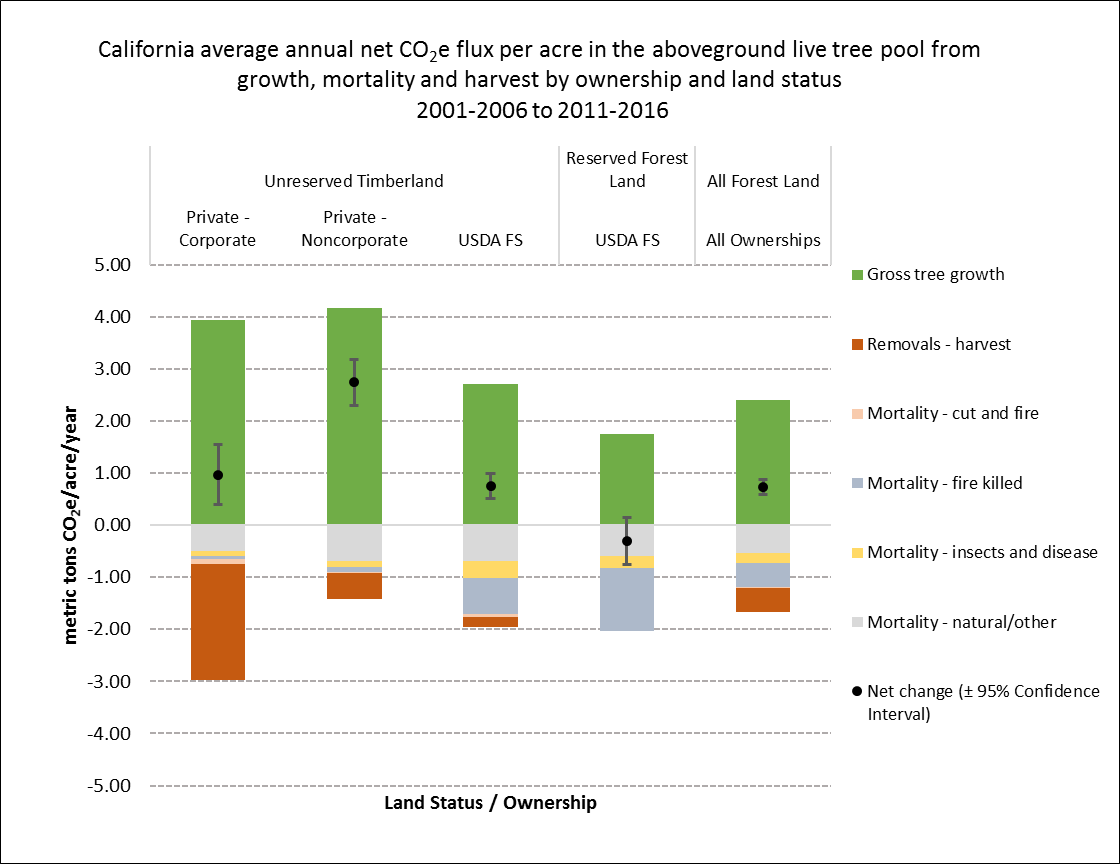
Figure 4.4. Average annual net CO2e flux per acre in aboveground live tree carbon pools
The tall green bar shows gross carbon capture per acre across different ownerships. The negative grey and yellow bars show mortality from fire, insects, disease, and other causes. The brown bar is removals of wood that goes to sawmills and bioenergy plants where we use the products that are produced there instead of fossil fuel intensive products such as cement, natural gas, and plastic. It is noticeable that mortality losses per acre on National Forest System timberlands and reserve lands (the non removal categories) are more than double those on an average acre of private timberland.
Our study and demonstration project involves exploring options that various landowners will have for avoiding carbon crashes and potential strategies for National Forest lands to reduce high mortality losses. Stands will range from even-aged plantations to multiaged stands with old forest structures. The working hypothesis that unifies our project is that ‘best practice’ low-intensity maintenance treatments can substantially reduce mortality rates (and, therefore, related carbon emissions) for a broad range of landowners if applied more widely. Consequently, we have revised our carbon sequestration estimate analysis to focus primarily on the estimated benefits of maintenance fuels/forest health treatments that do not require analysis of complex forest products supply chains. The basis for the estimate of project-level carbon sequestration benefits is to apply ‘best practice’ fuels/forest health treatments that are relatively low-impact from a short-term carbon emissions perspective. We are treating stands that, if not treated now while treatment costs are relatively low, will become carbon-weak instead of carbon-strong.
In addition to carbon sequestration benefits, this project aims to better calibrate the benefits of these best practice treatments for specific stand structures and disseminate the results to encourage wider use of these practices. For projecting our project’s overall GHG benefit, we place a high burden of proof on the calculation, using realistic and relatively conservative estimates of project benefits for the parameters that go into estimating carbon impact.
Document:
The ‘Document’ objective is to continue pre- and post-monitoring practices used at Blodgett Forest Research Station and other Berkeley Forests over the past 40 years to consistently capture the immediate carbon impacts of treatments, medium- and long-term carbon impacts on treated and untreated (control) stands, and changes in predicted fire behavior. These data will be incorporated into the Berkeley Carbon Calculator, a tool that forest landowners and managers can use to calculate the carbon benefits of treatments. As of 2015, the Berkeley Carbon Calculator is the only carbon calculator that is parameterized to the four major types of managed forests in California. It has been published in a peer-reviewed journal, (Stewart and Sharma 2015) and is based on the most recent literature based coefficients (e.g. Morgan 2012, Stewart and Nakamura 2012) of carbon mass balances at the harvest site, sawmill, wood energy plants, and post-consumer waste utilization steps. Carbon calculators based on single case studies from single forests may or may not be applicable to other forest types or other management regimes. A key ongoing component of this project will be to improve the Berkeley Carbon Calculator so that forest growth data from other systems such as FORSEE, FVS, and empirically based regional growth curves can be integrated into the full life cycle analysis of harvested forest products as well as the forest regeneration projections.
Disseminate:
In the initial phase of the project, we will interview landowners and foresters to better understand what materials and interaction methods best meet their needs. The Center will develop documentation materials and actively promote forest offset projects through field visits, webinars, Youtube videos, presentations at California Licensed Foresters Association (CLFA), and other events.
 Bill Stewart
 Rob York
 Scott Stephens